Custom straws stopped being a novelty the moment single-use plastic straws started disappearing from menus. For a cafe, event planner, or brand running a promotion, a printed straw is a cheap, high-visibility branding surface — but “custom straws” now covers everything from a compostable paper tube to an engraved metal straw meant to last for years. The material you choose decides the cost, the printing method, how the straw behaves in the drink, and whether it fits the venue’s sustainability rules. Here is how the main options actually compare, and how to match one to your use case.
Why the material question came first
The shift away from plastic is regulatory, not just fashionable. A growing list of U.S. states and cities restrict single-use plastic straws — many now require that straws be provided only on request or be made from an approved non-plastic material — and the EU and UK go further, treating some bioplastics as plastic under their bans. That is the backdrop to every custom-straw order: if the straws are going into a venue or event that has to meet a local rule, the substrate you print on has to clear that rule first. Get the material right and the branding is the easy part.
Paper straws: the default for events and foodservice
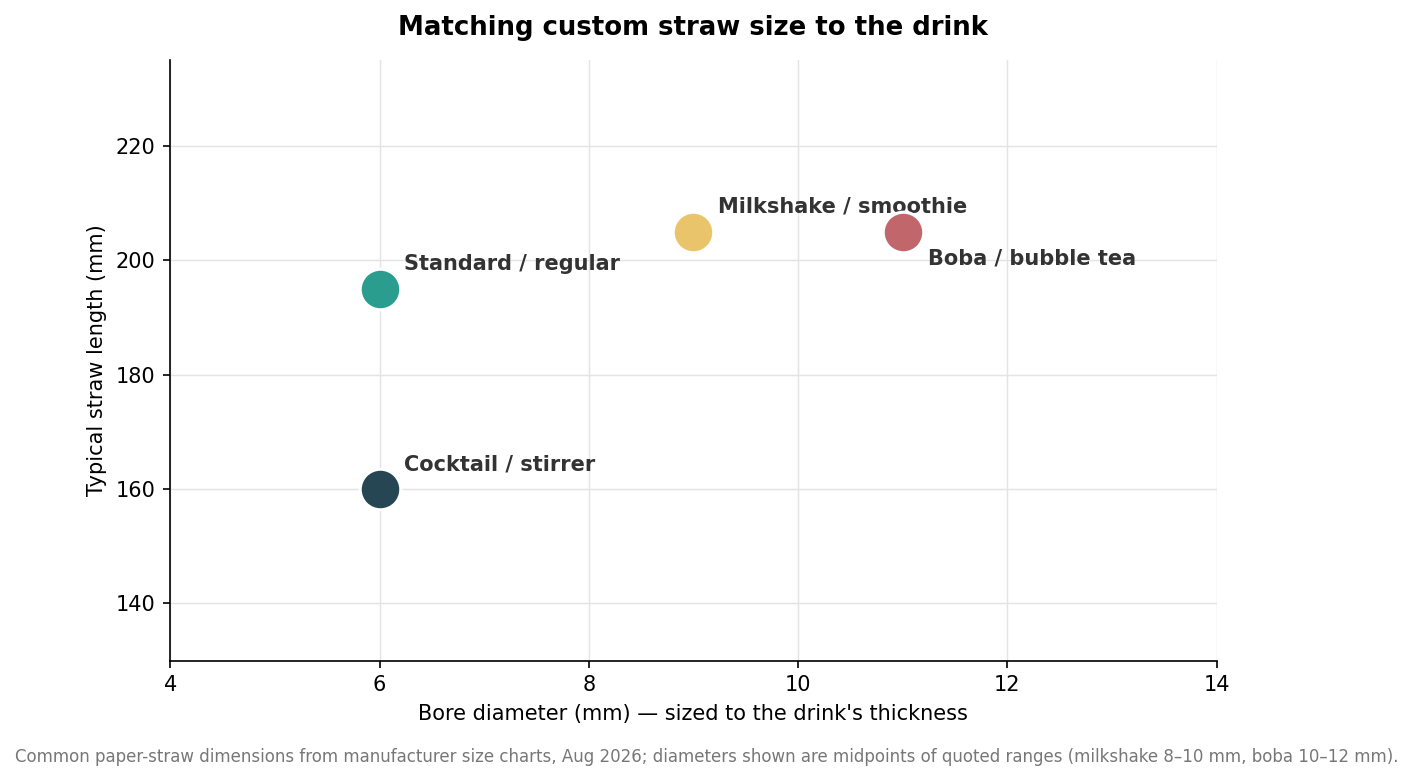
Paper is the workhorse of the custom-straw world because it is inexpensive, genuinely compostable, and easy to print. Sizing is the first decision, and it is dictated by the drink rather than by taste. A cocktail or stirrer straw runs about 6 mm across and 140–180 mm long; a standard straw is also around 6 mm but longer, roughly 180–210 mm; a milkshake or smoothie straw widens to 8–10 mm; and a boba or bubble-tea straw needs 10–12 mm to pass tapioca pearls. Ordering a straw that is too narrow for the drink is the most common and most avoidable mistake, so match the bore to the thickest thing that has to travel up it.
Durability comes down to ply, the number of paper layers wound into the wall. Three-ply is the common standard; a four-ply upgrade resists going soggy noticeably longer and is worth it for slow-sipped or hot-adjacent drinks. Two details are worth insisting on: food-safe inks (reputable makers use them as standard) and PFAS-free certification, because some paper straws have historically used “forever chemical” coatings for water resistance that undercut the whole point of going compostable. Printing is typically flexographic, with up to two spot colors as the standard offering and custom color matching available; individually paper-wrapped straws add a hygienic, brandable sleeve on top of the printed straw itself. Minimums are the trade-off — stock colors and stock prints ship in small quantities, but a fully custom-printed straw design often carries a high minimum (into the thousands, sometimes around 10,000 units at a given factory), so a small run usually means choosing from existing prints or branding the wrapper instead.
PLA and compostable bioplastics: read the fine print
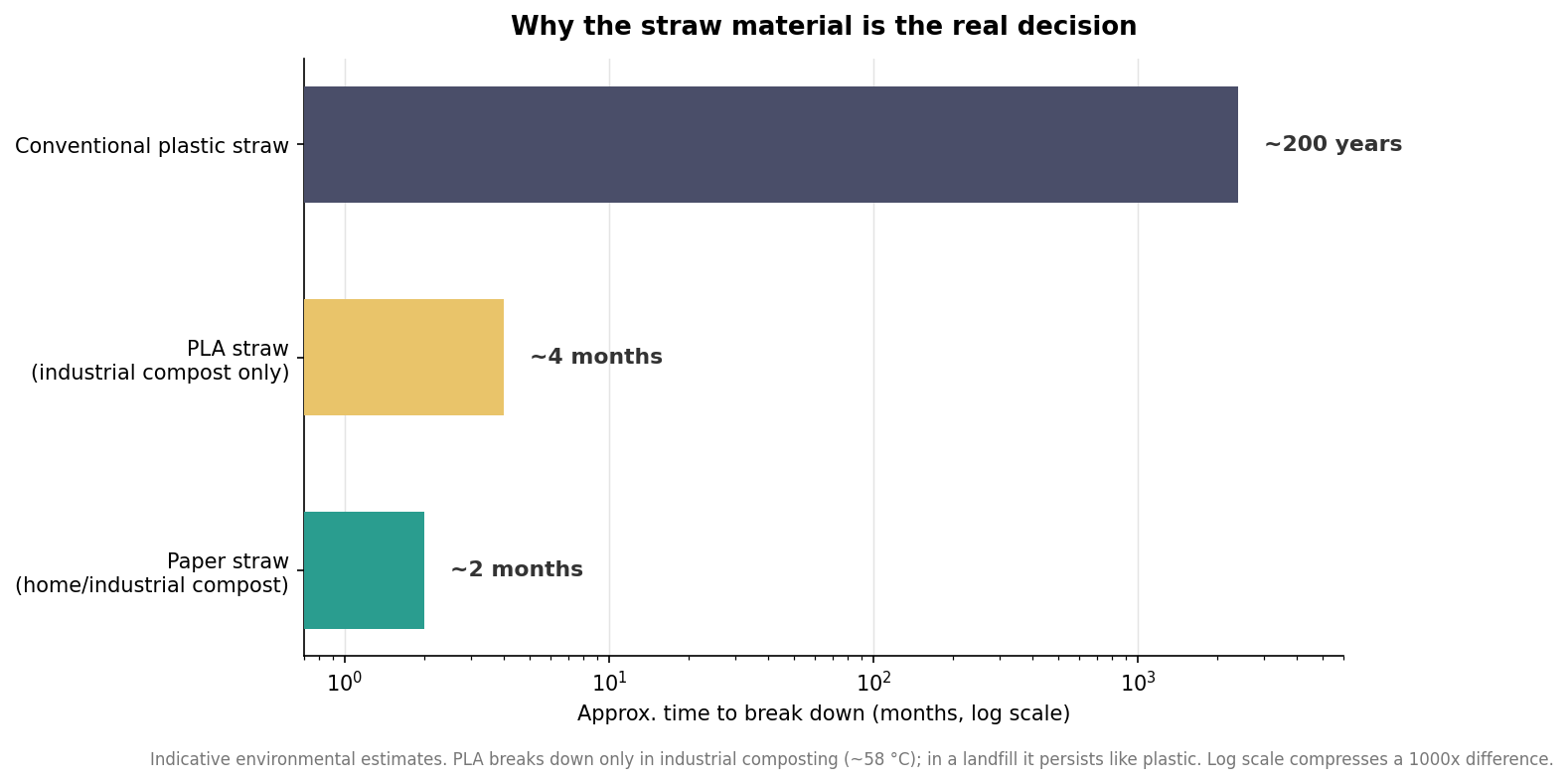
PLA straws look and feel like plastic and hold up better than paper in a cold drink, which makes them tempting. The catch is disposal. PLA breaks down only under industrial composting conditions — sustained heat around 58–60 °C for days — and in a home compost or a landfill it behaves much like conventional plastic. It also has a low heat tolerance, softening at roughly 55–60 °C, so it is a cold-drink material and not suitable for hot beverages. And because the EU and UK classify PLA as plastic under their single-use rules, it is not a safe universal substitute where those bans apply. PLA earns its place when you specifically have access to commercial composting and want a plastic-like feel; otherwise its green credentials are conditional in a way paper’s are not.
Reusable straws: metal, silicone, glass, and bamboo
Reusable straws are a different product with a different job. Instead of a disposable printed with a logo, you are making branded merchandise meant to be kept. Stainless steel straws are near-indestructible and are branded by laser engraving rather than ink; silicone straws are soft, kid- and cyclist-friendly, and take a printed or debossed logo; glass straws look premium and let drinkers see they are clean but are fragile; bamboo reads as natural but wears over time. These suit retail sets, conference gifts, and loyalty programs where the reuse itself is the sustainability story — one engraved steel straw quietly replaces hundreds of disposables. Expect higher unit costs, and remember that the durable ones are usually sold with a cleaning brush and pouch, which are additional brandable surfaces.
Matching the straw to the use case
Work backward from where the straw will be used. For a high-volume event or a cafe that has to meet a plastic-straw rule, custom paper straws — three-ply for cold, four-ply or wrapped for anything slower — are the practical answer, with the logo on the straw or its wrapper. For a bubble-tea or smoothie program, size is the whole game: order 10–12 mm paper straws and confirm the ply, because a wide straw goes soggy faster. For a brand giveaway or retail line where longevity and perceived value matter more than disposability, a reusable metal or silicone straw with an engraved or printed logo does more for the brand than a disposable ever will. And if a venue you are supplying has genuine access to industrial composting, PLA becomes a reasonable cold-drink option — but confirm that composting access rather than assuming it, because without it the environmental case largely disappears. Decide the material against the venue and the drink first, and the printing, sizing, and minimums fall into place from there.